
Overbilling in healthcare can drain financial resources and damage trust between providers and patients. But that’s just one side of the problem. Conversely, underbilling can lead to lost revenue and missed growth opportunities. Striking a balance is crucial for any healthcare organization aiming for profitability and compliance.
This blog explores the most effective ways to prevent underbilling and overbilling using the latest strategies and technologies in 2025. Whether you’re a healthcare provider, a medical billing expert, or a healthcare administrator, this blog will equip you with actionable insights to enhance your billing accuracy.
Understanding the Billing Challenge
Before diving into solutions, let’s briefly look at why billing discrepancies occur in healthcare:
Cause of Billing Errors | Impact |
Incorrect Coding | Overbilling or underbilling |
Data Entry Mistakes | Billing discrepancies |
Incomplete Documentation | Missed charges (underbilling) |
Miscommunication Between Departments | Duplicate charges (overbilling) |
Billing errors are not just about financial loss. They can also result in compliance issues, leading to audits, penalties, and a damaged reputation.
Latest Strategies to Prevent Underbilling and Overbilling in 2025
1. Leverage Advanced Billing Software
Modern billing software, powered by artificial intelligence (AI) and machine learning, can help you detect and prevent billing errors in real-time. These systems can flag anomalies and provide recommendations for corrections.
- Automated Error Detection: Instantly identify and correct billing mistakes.
- Data Analytics: Monitor billing patterns to spot irregularities.
- Integration with EHR Systems: Sync patient data for accurate billing.
2. Conduct Regular Billing Audits
Regular internal and external audits can help you spot and correct errors before they escalate.
- Internal Audits: Regularly review billing records and compare them with patient charts.
- External Audits: Partner with third-party auditors for an unbiased review.
3. Train Your Billing Staff Continuously
Billing regulations and coding standards frequently change. Regular training ensures your staff stays updated.
- Quarterly Training Sessions: Cover updates in coding and compliance.
- Certification Programs: Encourage staff to earn relevant billing certifications.

4. Implement Strict Documentation Protocols
Accurate documentation is the backbone of precise billing. Ensure that all patient interactions, treatments, and procedures are thoroughly documented.
- Use Structured Templates: Standardize how information is recorded.
- Promote Real-Time Documentation: Encourage providers to document immediately after services.
5. Monitor Payer Contracts Closely
Stay aware of the terms in your payer contracts to avoid unexpected billing issues.
- Review Contract Terms Annually: Ensure you understand the latest reimbursement rates.
- Track Denied Claims: Analyze why claims are denied, preventing future issues.
6. Utilize Predictive Analytics
Leverage predictive analytics to identify areas where billing inaccuracies are most likely.
- Predictive Error Detection: Spot patterns leading to errors.
- Revenue Forecasting: Estimate potential revenue losses due to billing issues.
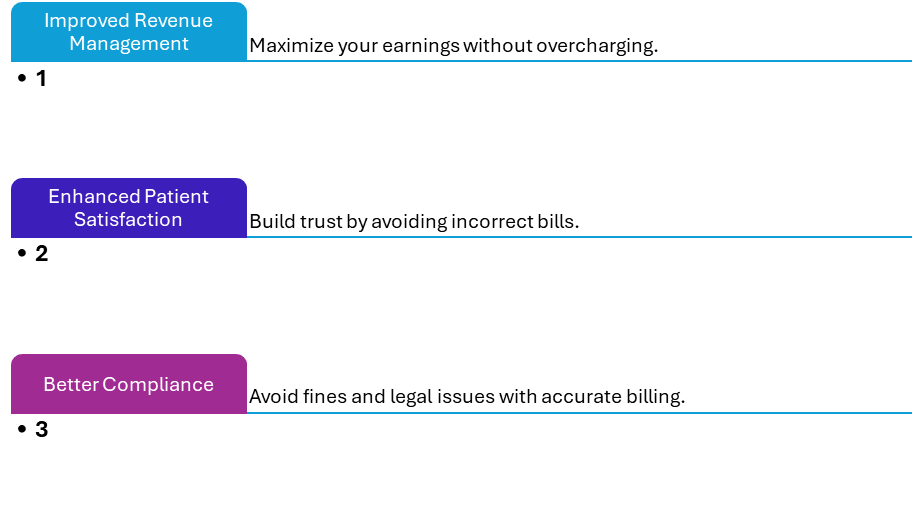
Key Benefits of Accurate Medical Billing
How Technology is Revolutionizing Medical Billing
Advanced technologies are revolutionizing healthcare billing in 2025, making it more accurate and efficient. AI-powered auditing systems automatically detect billing inaccuracies, ensuring errors are identified and corrected in real-time. Blockchain technology secures patient data, preventing unauthorized access and reducing the risk of fraudulent claims. This enhanced data security fosters patient trust and ensured compliance with data protection regulations.
Moreover, machine learning algorithms predict and prevent billing discrepancies by analyzing historical billing patterns and flagging potential errors before they occur. Robotic Process Automation (RPA) takes over repetitive billing tasks, such as data entry and claim submissions, reducing human error and increasing productivity. Together, these technologies streamline billing processes, cut costs, and improve financial performance for healthcare providers.
Medical Billing Inaccuracies: Real-Life Impact
Medical billing inaccuracies can lead to severe consequences, from lost revenue to compliance issues. For example, a hospital that miscodes procedures may lose thousands of dollars in reimbursements or, worse, face legal penalties for incorrect billing.
To avoid this, healthcare providers must ensure that their billing processes are accurate, transparent, and compliant with the latest regulations.
How to Fix Billing Discrepancies Effectively
Billing discrepancies can be a major headache, but they’re fixable with a systematic approach:
- Identify the Cause: Whether it’s a coding error, missing documentation, or a system glitch.
- Correct the Error Promptly: Use your billing software to make necessary corrections.
- Educate Your Team: Conduct post-error training sessions to prevent repeat mistakes.
- Review Regularly: Ensure ongoing monitoring of your billing processes.
Conclusion: Streamline Your Billing with TronsIT Solutions
Billing errors are a critical issue in healthcare, but they don’t have to be a constant struggle. By adopting the right technology, training your staff, and maintaining strict documentation protocols, you can minimize both underbilling and overbilling.
And if you’re looking for a seamless solution, TronsIT Solutions offers advanced billing software and services designed to prevent billing errors, optimize your revenue, and ensure compliance. With TronsIT Solutions, you can take control of your billing process with confidence.
For more insights, explore our website!